What Is an AI Apparel ERP and How Does It Work
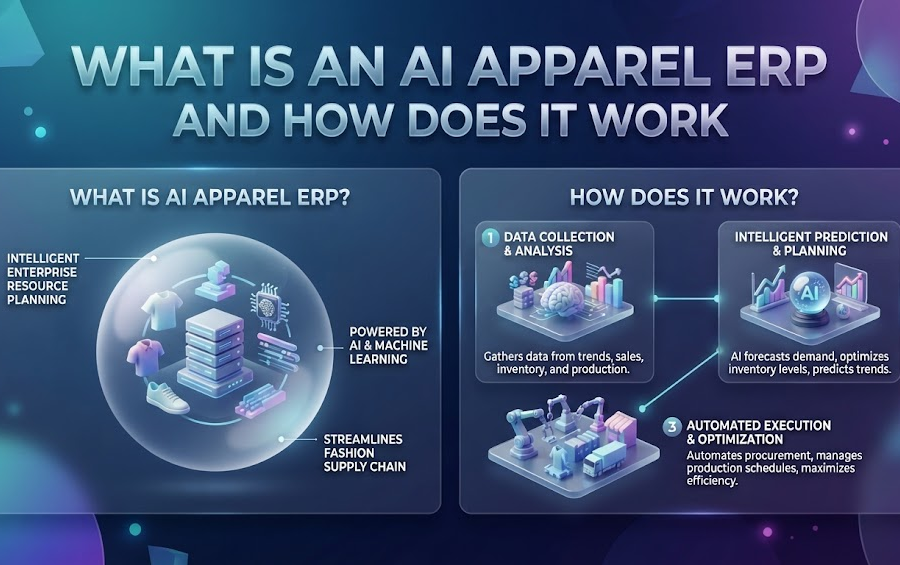
Every apparel brand has a version of the same Monday morning. Someone opens a spreadsheet that was accurate last Thursday, someone else asks why the navy in size medium is showing available when the warehouse pulled the last of it on Friday, and a third person is on the phone with a mill about a fabric that was substituted three weeks ago and never made it into the bill of materials. Nothing here is catastrophic. It is just friction, and friction is where margin quietly goes to die.
For twenty years the answer to that friction was enterprise resource planning software: one database, one version of the truth, every function reading from the same numbers instead of emailing each other attachments. But traditional ERP is fundamentally a system of record. It tells you what happened, accurately and in order, and then waits for a human to decide what it means.
The newer category keeps that record-keeping spine and adds a layer that reads patterns in the data and proposes what to do next. It is less a new product than a new posture: the filing cabinet starts behaving like a colleague who has read every order you ever shipped.
From System of Record to System of Suggestion
The distinction matters more than the marketing usually makes clear. A conventional ERP will happily show you that style 4402 in cobalt sold 300 units last season. An intelligent one notices that cobalt sold through in eleven days in the Northeast, stalled in the Southwest, and that the same color pattern held for two prior seasons, then flags your proposed buy as skewed before the purchase order goes out.
That shift depends on forecasting methods that matured only recently. Researchers working directly on fashion supply chains have argued in a position paper on learning-based forecasting that short product life cycles and volatile demand make apparel one of the strongest candidates for machine learning, precisely because the guesswork is so expensive when it goes wrong.
The Data Layer Is the Whole Game
AI inside an ERP is only as sharp as the records underneath it, and apparel records are messy in specific, recognizable ways. Colorways get renamed mid-season. The same fabric arrives under two supplier codes. Returns get logged against the parent style rather than the SKU that actually came back.
Federal guidance makes the same point in blunter language: the GSA’s AI strategy requires that every dataset feeding a model carry documented provenance, quality measures, and lineage, so that a recommendation can be traced back to the numbers that produced it. A brand does not need federal-grade governance, but the principle transfers cleanly. If you cannot explain where a suggestion came from, you will not trust it, and a suggestion nobody trusts is just noise.
Where the Intelligence Actually Shows Up
In practice, the useful applications cluster in four places. Demand forecasting is the obvious one, sizing the buy by style, color and size rather than by gut. Replenishment timing is the quieter one, watching sell-through velocity and nudging a reorder before the fast sizes go dark. Allocation between wholesale and direct channels is where the money is, since committing the same physical units twice is a relationship problem as much as an inventory one. And exception detection may be the most valuable of all: the system flags the order that looks nothing like the pattern, while there is still time to fix it.
A good AI apparel ERP does all four against live operational data rather than a monthly extract, which is the difference between a recommendation you can act on and a report about a decision you already missed.
Compliance, Sourcing, and the Long Tail
Apparel is also a cross-border business, and that adds a category of work that automation handles well. Duty classifications, country of origin documents, and supplier certifications all live as structured fields, which is exactly what models are good at checking. Since the Agreement on Textiles and Clothing expired and garment trade returned to general WTO rules, sourcing has scattered across more countries with more paperwork attached, and an ERP that flags a missing certificate before shipment is worth more than one that files it neatly afterward.
Implementation Is Where Most of This Is Won or Lost
The failure pattern is consistent, and it is not technical. Brands buy the intelligence layer and then feed it three years of inconsistent history, or they automate a process that was broken to begin with. Anyone weighing this should read up on how automation projects actually succeed before scoping a rollout, because the sequencing advice applies almost word for word.
Start narrow. Pick one decision that is currently made on a hunch, run the system against it for a season, and compare its call against what you would have done. That comparison is the only proof that matters, and it costs a fraction of a full deployment.
Closing Thoughts
An AI apparel ERP is not a machine that runs your brand. It is a system that has read your history more carefully than you have time to, and that says so out loud at the moment a decision is being made. The judgment stays with the merchandiser, the planner, the person who knows why last spring went the way it did.
What changes is the quality of the input to that judgment. Fewer meetings spent reconciling numbers, fewer surprises at the end of a season, fewer weeks lost to a size curve nobody caught. Over a year that compounds into something that looks a lot like a better run business, which was the point of ERP in the first place.

Writer at ShotScribuss, covering the latest in tech and gadgets.